
Ella Rabiei
Product Design Portfolio
aivo
AI Driven SAAS Platform
The Smart Productivity Hub for Teams
Spring 2025
Role: Project Lead
This is a project collaborated with AI, and all data is altered due to privacy.

Overview:
As digital collaboration grows more complex, teams juggle countless tools, from task managers to communication apps and analytics dashboards. While these tools are powerful, they often create more noise than clarity.
New team members struggle with steep learning curves, and even experienced users spend valuable time interpreting data rather than acting on it.
At the same time, AI technology is rapidly evolving, offering opportunities to simplify workflows, reduce cognitive load, and make software feel more intuitive and adaptive to individual users.
Recognizing this gap, avio was conceptualized as a next-generation SaaS productivity hub, one that combines smart automation with human-centered design to help teams work more efficiently and confidently.
Introduction
avio is an AI-powered SaaS platform designed to:
-
Unify team workflows
-
Simplify onboarding,
-
Turn data into actionable insights.
This platform learns from how each user and team operates, adapting its interface, recommendations, and analytics to their unique habits and goals. Instead of overwhelming users with information, aivo focuses on clarity and action: surfacing what matters most, when it matters. Whether it’s guiding a new team member through onboarding, identifying bottlenecks in a project, or summarizing weekly progress, aivo acts as a collaborative AI assistant that empowers teams to stay aligned and productive.
My vision was to redefine how teams interact with their digital tools, shifting from static dashboards and generic workflows to intelligent, adaptive systems that understand human context and amplify focus.
Research
To understand how professionals manage their daily workflows and what challenges they face with existing productivity tools, I conducted a mix of interviews and surveys with:
-
Project Managers (to learn about coordination pain points)
-
Designers & Developers (to uncover usability and context-switching frustrations)
-
New Team Members (to explore onboarding struggles)
The goal was to identify patterns in how people experience complexity, information overload, and lack of clarity in their daily work.
Users' Key Insights
-
Users reported spending significant time switching between apps like Notion, Jira, Slack, and Google Sheets. This constant context switching created mental fatigue and reduced productivity.
-
Many users skip or ignore product tutorials because they feel too generic or time-consuming. They prefer contextual help that appears when it’s relevant to what they’re doing.
-
Users expressed frustration with dashboards that display lots of charts but fail to translate insights into clear actions. They want tools that tell them what matters most right now.
-
Users are open to AI assistance, but only if it feels collaborative, transparent, and optional, not controlling. They value suggestions over automation, and insight over oversight.
-
The best software experiences are ones that adapt to user patterns, anticipating what they might need next, surfacing shortcuts, and reducing repetitive tasks.
What Needs To Be Considered
-
Updates: Platform should integrate seamlessly with existing tools and provide a centralized view of priorities and updates.
-
Onboarding: Introduce AI-powered, adaptive onboarding that personalizes guidance based on the user’s behavior, role, and experience level.
-
Reminders: Design action-oriented dashboards that highlight priorities and generate AI-driven recommendations, such as “You’re behind on client review, reschedule the sync?”
-
Support: Platform's AI tone and interaction style should feel supportive, conversational, and human-centered, focusing on empowerment, not enforcement.
-
Personalization: Incorporate predictive personalization, where platform learns from usage patterns to suggest shortcuts, automate recurring workflows, or adjust dashboards dynamically.
Benchmarking
Existing Platforms
-
Userpilot: Focuses on in-app onboarding, behavioural triggers, tooltips, guided tours.
-
Pendo & similar DAPs (digital adoption platforms): Provide analytics on feature usage, user flows, and more.
-
HubSpot: Offers automation, workflow, analytics in CRM + marketing context, good for part of the “data + action” side.
-
LumApps: AI-driven onboarding for employees (rather than full team workflow hub), shows the trend in onboarding automation.
What could work based on Benchmarking Data
-
Unified workflow across tools: Many platforms handle onboarding or analytics, but fewer act as a central hub across a team’s tool-stack (task management, communication, data).
-
AI-driven actionable insights: Dashboards that don’t just show data, but recommend actions are less common.
-
Adaptive onboarding + role/team context + predictive assistance: While onboarding tools exist, ones that deeply adapt based on user behaviour, role, team health are scarce.
-
Human-AI collaboration tone: Many tools automate tasks, but fewer focus on the AI being a “companion” rather than just automation, which you emphasise.
-
Team health / predictive features: Detecting e.g., bottlenecks, burnout, collaboration friction and surfacing them proactively is a frontier.
SaaS platforms are not totally novel in every component, but the combination of these features into one cohesive product (adaptive onboarding + unified hub + actionable AI insights) has not widely practiced yet.
Aivo’s differentiator:
It combines the best of these worlds into a human-centered AI productivity hub that:
-
Learns from user behavior to simplify onboarding.
-
Connects data across tools to create meaningful insights.
-
Translates dashboards into clear, actionable guidance.
Design Opportunities
Based on the research, user insights, and competitive analysis, several key opportunities emerged for designing a more intelligent, adaptive, and human-centered productivity platform.
Simplify Complexity Through Adaptive Onboarding
-
Insight: Users feel overwhelmed by traditional onboarding processes that dump information all at once.
-
Opportunity: Reimagine onboarding as an ongoing, conversational experience instead of a one-time tutorial. Use AI to observe user behavior and deliver just-in-time guidance, role-based setup, and contextual tooltips that appear naturally as users explore.
-
Design Principle: Onboarding should feel like mentorship, not a manual.
Turn Data Into Actionable Insights
-
Insight: Teams are flooded with dashboards and metrics, but lack clarity on what to focus on.
-
Opportunity: Use AI to synthesize data from multiple tools (like Notion, Jira, Slack) into clear, actionable recommendations. Instead of raw analytics, provide proactive summaries, e.g., “Your sprint progress dropped 15%. Would you like to adjust priorities or schedule a sync?”
-
Design Principle: Don’t just show data — translate it into decisions.
Create a Unified Workspace Across Tools
-
Insight: Constantly switching between apps fragments focus and slows productivity.
-
Opportunity: Design a centralized hub that integrates with existing tools and aggregates relevant data into one cohesive view. This helps users manage everything, tasks, communication, insights, from a single dashboard.
-
Design Principle: One place for everything that matters.
Design for Human-AI Collaboration (Not Control)
-
Insight: Users welcome AI support, but only if it feels transparent, optional, and empathetic.
-
Opportunity: Craft interactions where the AI acts as a collaborative partner, not a boss. Let users ask questions in natural language (“What should I prioritize today?”) and maintain full control over actions.
-
Design Principle: The AI should guide, not decide.
Predict and Prevent Problems Before They Escalate
-
Insight: Teams often realize they’re off-track or burnt out after it happens.
-
Opportunity: Leverage predictive AI to detect patterns like delayed tasks, communication drops, or workload imbalances, then surface gentle, proactive nudges or recommend preventive steps.
-
Design Principle: Anticipate needs, don’t just react to them.
Foster Emotional Clarity and Calm Through Design
-
Insight: Overly complex interfaces cause stress and fatigue, especially during busy workweeks.
-
Opportunity: Adopt a minimal, balanced visual system with generous whitespace, soft color palettes, and subtle motion cues to help users feel focused and in control.
-
Design Principle: Clarity is emotional, calm interfaces build trust.
Focused Area | Painpoints | Opportunities |
|---|---|---|
Interface | Cognitive overload | Calm, minimal, trust-building UI |
Team Health | Burnout and missed signals | Predictive, proactive insights |
AI Trust | Fear of automation | Human-centered, transparent AI |
Workflow | Tool overload | Unified productivity hub |
Data | Too much information, not enough insight | Action-oriented AI summaries |
Onboarding | Overwhelming, irrelevant tutorials | Adaptive, AI-guided onboarding |
Finalized Design
Dashboard
The new design introduces a comprehensive team management and onboarding experience for both employers and employees. It provides visibility into day-to-day team activities and workload distribution, helping managers identify imbalances and offering actionable recommendations to promote a healthier and more productive work environment.
The dashboard delivers key insights into team performance, task allocation, top contributors, recent activities, and other critical metrics, enabling managers to make informed decisions and maintain alignment across their teams.


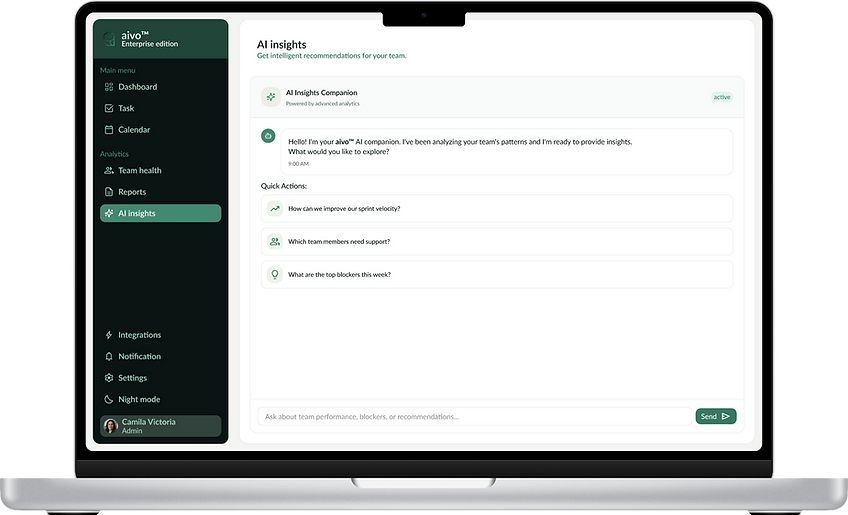
Integrated AI
An integrated AI-powered insights feature further enhances the experience by helping managers uncover opportunities to improve sprint velocity, identify team members who may benefit from additional support, and anticipate potential blockers before they impact delivery. The platform also provides practical, business-focused recommendations to help teams proactively address challenges and achieve their goals more effectively.

Team health
Team Health provides a comprehensive view of workforce wellbeing by monitoring workload distribution, employee satisfaction, productivity, and collaboration levels. It evaluates team performance across key indicators such as individual contributions, sprint velocity, and quality of work, helping managers understand both team and individual performance. Through real-time insights and detailed reporting, Team Health highlights each team member's current workload, capacity, and overall balance, enabling leaders to make informed decisions that support productivity, engagement, and long-term team success.

Task management
Task Management enables managers to effectively track team progress and performance across all active tasks while maintaining visibility into priorities and deadlines. The platform provides a clear overview of each team member's contributions, workload, and task status, while highlighting the relative importance and urgency of individual assignments. This helps managers make informed decisions, allocate resources more effectively, and ensure that high-priority work remains on track.

Onboarding
The onboarding experience helps new employees stay organized and confident throughout their transition into the team. It provides a clear day-by-day view of training activities, required tasks, and key milestones, while also giving employees visibility into broader team goals, objectives, and organizational priorities. The platform encourages early connection and collaboration by helping new hires get to know their teammates and build relationships with their peers. In addition, it centralizes all essential resources, tools, and learning materials, ensuring employees have everything they need to successfully begin their role and become productive more quickly.


Conclusion
Aivo reimagines workforce management by combining team health, performance insights, onboarding, and AI-driven recommendations into a single, intuitive platform. By providing leaders with real-time visibility into workload distribution, employee wellbeing, collaboration, and productivity, Aivo empowers organizations to make more informed decisions that support both business outcomes and employee success. The result is a healthier, more engaged workforce, stronger team performance, and a workplace culture where people can thrive while delivering their best work.